
Lake County Past-Resident Sources
No single roll lists every person tied to a Lake County address. The present assessment card supplies the parcel and owner lead. Recorded deeds then carry ownership backward, while plats preserve lot identity when street labels fail. Household evidence comes from directories and census schedules, not from the property roll alone. The source mix also changes at key dates, so a careful search uses the right medium for each era.
| Lake County source | Verified span | Access point | Useful evidence |
|---|---|---|---|
| Clerk plats | October 11, 1884 to present | Clerk research room and index | Subdivision, lot, block, roads, and easements |
| DEED books | August 5, 1887 to December 31, 1956 | Clerk books and microfilm | Earlier owners, parties, and legal descriptions |
| Official Records | January 1, 1957 to present | Clerk web search and office media | Deeds, mortgages, liens, releases, and recording data |
| Federal census | Public schedules through 1950 | FamilySearch and licensed library databases | Households at an enumeration date |
| Local directories | Verified digital volumes for 1924-25 and 1939 | Leesburg Public Library digital collection | Listed residents, spouse, work, address, and phone |
Start with LC PARS for a current parcel, even when the question concerns the distant past. Its sales links are leads, not a full title chain. For a mid-century search, move from Official Records into the separately coded DEED books at the 1957 boundary. For an older Lake County address, keep the plat and legal description in view. The surviving plat run predates the county itself, which makes it vital when a current address did not yet exist.
Bridge Lake County's 1957 Divide
The Lake County Clerk separates modern Official Records from earlier deed volumes. Search the Official Records index by party name, document type, recording dates, instrument number, or book and page. Names follow the spelling on the instrument. When one form fails, try initials, former names, trust wording, and exact business styles.
A chain that reaches 1956 must continue in DEED books, not stop at a blank web result. Public computers are available in Official Records at 550 W. Main Street in Tavares. Older books and microfilm may also require staff help or Records Storage at 313 S. Bloxham Avenue. Call Official Records at 352-253-2600 before a long visit. The Clerk cautions that online index details can be partial or stale, and some old dates are approximate. An image missing online can still remain open for office inspection.
For files that cannot be located through the index, use the counter, phone, mail or email route. Non-court public-record requests may go to PublicRecordsRequest@lakecountyclerkfl.gov or 352-343-9770. State-retained material can require a State Archives catalog search. This fallback chain matters because digital access never replaced all courthouse media.
Trace Lake County Owners Backward
Ownership is the firmest frame for researching previous residents, but an assessed owner is not proof of who slept at the site. LC PARS shows the current assessed owner, mailing and situs addresses, parcel number, alternate key, condensed legal description, exemptions, improvements, and linked sales. Copy the parcel and legal description before following a sales citation to the Clerk.
- Find the current parcel by situs address. Save the owner, parcel or alternate key, legal description, and sales book/page.
- Open the current owner's acquisition deed. Confirm that its lot, block, subdivision, or metes-and-bounds description matches.
- Take the seller, or grantor, and search that person as an earlier grantee. Record each date, instrument, and cited prior deed.
- Repeat the link. At January 1957, move from Official Records to the older DEED series.
- If the web trail breaks, use alphabetical indexes, book/page, public computers, microfilm, and staff help at the Clerk.
- Grantor and grantee
- The grantor gives or sells an interest; the grantee receives it.
- Chain of title
- The linked series of transfers for the same land.
- Legal description
- The land's lot, block, survey, or boundary identity, which can outlast a street address.
- Situs address
- The location of the parcel, distinct from the owner's mailing address.
A homestead exemption may support an owner-occupancy clue, but it does not name all members of a household. Likewise, a permit can date a physical change and name parties to the work without proving residence. Treat both as supporting evidence.
Lake County Plats Outlast Addresses
The oldest cited item in the Clerk's plat series is an October 1884 Eustis plat. That is three years before Lake County was created. A surviving lot-and-block framework can connect a modern parcel to deeds written under old road names, rural routes, or a prior jurisdiction. Search the plat named in the property card, then compare the same lot and block in each deed. Do not rely on house number alone.
Lake County address traps include postal city labels that differ from municipal borders, annexations, rural E911 conversions, subdivision replats, and road renaming. GIS layers for city limits and annexations help identify the right permit or code office. Historic rural property may use section-township-range or metes-and-bounds wording rather than a neat subdivision lot.
The 1887 creation act adds another layer. Section 8 required Orange and Sumter officers to deliver certified copies of records tied to Lake County people and cases, and those copies had the force of originals. Yet broad work before 1889 may still reach Orange, Sumter, or other predecessor jurisdictions. A present Lake County address cannot simply be entered in an older county index.
Map Lake County's Past Residents
Fire-insurance maps can test whether a structure stood at a site and how a block was laid out. Verified Sanborn runs cover Leesburg from 1885 through 1924, Eustis from 1890 through 1922, Tavares from 1890 through 1920, Umatilla from 1906 through 1943, and Mount Dora from 1906 through 1920. Search the Library of Congress catalog by town and year, then match blocks, landmarks, and street labels to the plat.
The maps do not identify every occupant. They show building footprints, uses, and street context at a date. Pair them with a directory or census. Mount Dora Archives' Downtown by Decades project models this method by combining reconstructed maps, directories, yearbooks, newspapers, and community memory. Its ten maps span 1886 through the 1970s, but the reconstruction remains a guide back to the underlying evidence.
Lake County Deed-Media Guide
The Clerk's official research page is the source for book types and dates. Its coverage chart makes clear why a failed portal search is not proof that no transfer exists.
See the Lake County Clerk's historical coverage and research controls.
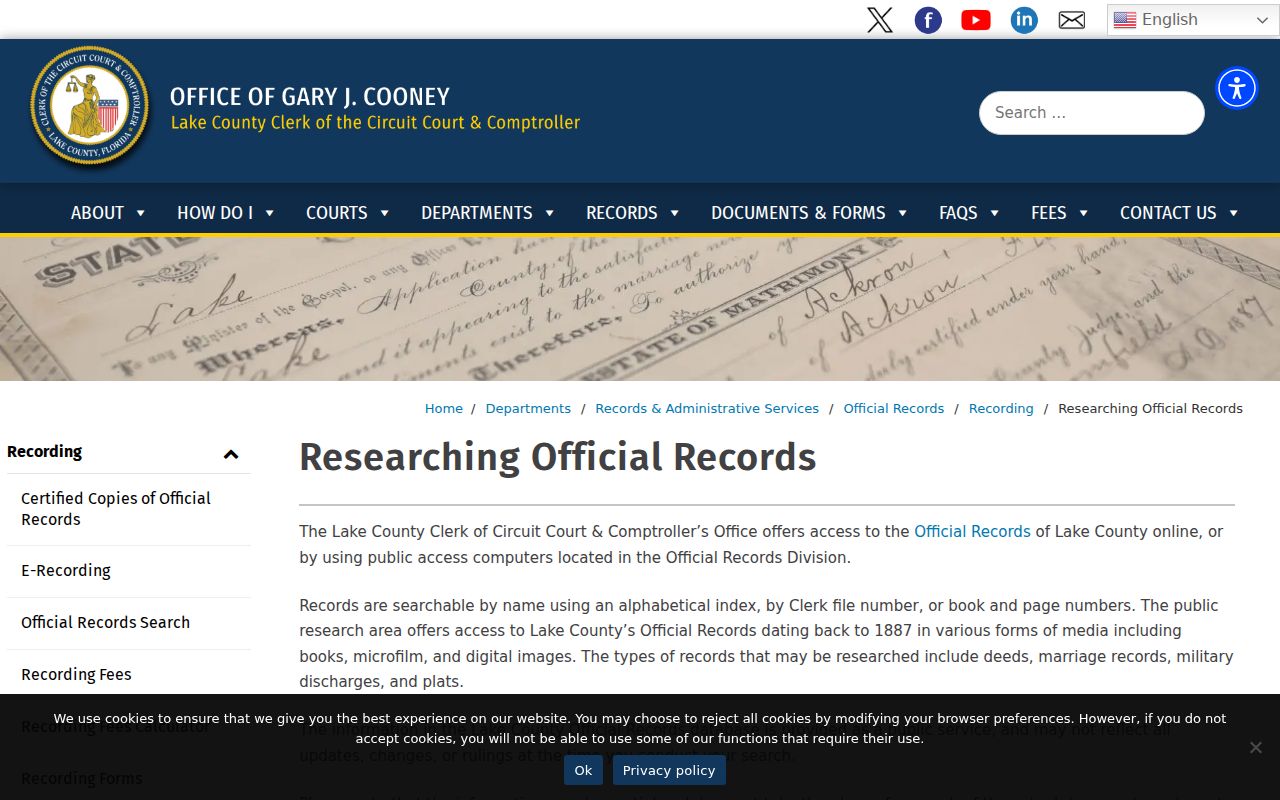
The captured page helps route a citation to the correct series before a courthouse or microfilm request.
Lake County Past Household Evidence
Deeds identify owners, not every occupant. The digitized 1924-25 and 1939 Polk volumes can add listed household names, spouse, occupation, address, phone, and status marks. The 1939 volume has 226 images, while the earlier volume has 530. Exact shelf years must be checked rather than assumed because no source proves a continuous countywide run. The full collections are described on the Lake County city directory page.
Pair each directory year with the nearest public federal census and browse the correct enumeration area after a name search. Florida's surviving 1885, 1935, and 1945 state schedules may bridge other gaps when locality coverage is verified. Follow this process:
- Copy the exact address and name spelling from the directory, including spouse and residence marks.
- Search the nearest census by name, then inspect adjacent schedule lines and the recorded street.
- Compare household members with the deed owner. A mismatch may point to relatives, boarders, or another occupant.
- Use newspapers, probate, cemetery records, and obituaries to explain a disappearance without assuming a move.
Lake County Library offers Ancestry Library Edition only inside a branch. HeritageQuest adds census, local histories, directories, land and probate material. FamilySearch catalog restrictions vary by image. For hands-on help, Kinseekers volunteers assist at Leesburg Public Library on Wednesdays from 10 a.m. to 1 p.m., and the State Library's Florida Collection is a fallback for editions not held locally.
Lawful use. Research past residents for house history, family history, and personal curiosity. Never use an address trail to stalk, harass, or harm a living person.
Mount Dora Previous-Resident Clues
Mount Dora Archives combines city, library, and historical-society holdings. Family histories, people and homes collections, minutes from 1916 to 1921, postcards, and land-boom records can supply names or old place labels. Archivist inquiries may go to creele@mountdora.gov. Each archive clue should be checked against a deed, directory, census, or contemporary newspaper.
Open the archive's digitized copy of The Story of Mount Dora.
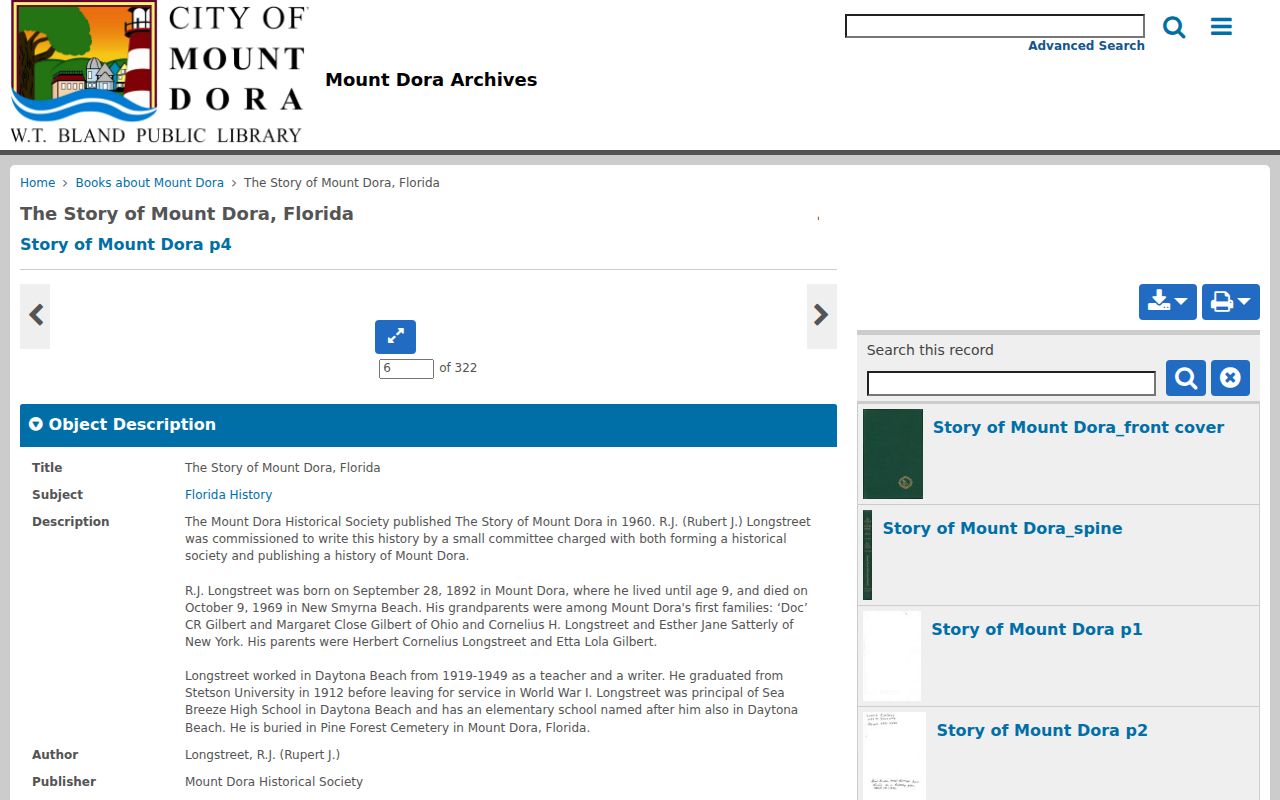
The 319-page local history can generate spelling, family, organization, and place leads, but contemporary records must confirm them.
The FamilySearch Lake County place catalog also routes searches to deed, probate, marriage, cemetery, church, and court material.
The catalog view is a finding aid; camera or key restrictions may control how a specific image can be read.